
Orbán Is Gone, Visegrád Group Is Back: Defense Reunites Central Europe
The Visegrad Four are returning to European security policy after several years. The decisive impetus came from the change of government in Hungary. The departure of Viktor Orbán and the appointment of Péter Magyar as the country’s prime minister removed the main political obstacle that had paralyzed the V4 countries’ joint approach following Russia’s invasion of Ukraine. The first joint meetings and the agenda of the Slovak presidency indicate that Central Europe is once again seeking common ground on issues of defense, the defense industry, military mobility, and the future expansion of the European Union. At stake is the return of the Visegrád Group as a regional bloc capable of influencing Europe’s strategic direction.
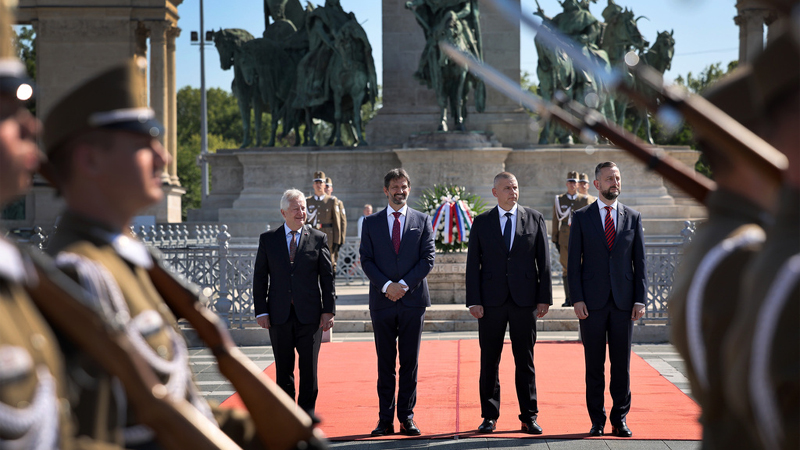
After February 2022, the Visegrád Four became a symbol of the deep political divisions in Central Europe. The Czech Republic and Poland were among Ukraine’s most active supporters; Slovakia, despite domestic political changes, sought to maintain a functioning regional dialogue; while Hungary, under the leadership of Viktor Orbán, pursued a markedly different approach toward Russia. The V4 gradually ceased to fulfill one of its most important functions: coordinating the positions of the four Central European countries ahead of key negotiations in the European Union and NATO. The region lost some of its political influence just as European security was undergoing its greatest transformation since the end of the Cold War.
Peter Magyar’s appointment fundamentally changed this trajectory. The new Hungarian government sent a clear signal to its partners that restoring trust is one of Budapest’s foreign policy priorities. Upon taking office, Magyar declared that “a strong Central Europe means a stronger Europe” and described cooperation with neighboring states as the foundation of Hungary’s European policy. The change in the political climate made it possible to revive formats that had practically ceased to function in previous years.
This shift is also confirmed by the program of the Slovak presidency of the Visegrád Group for the period from July 2026 to June 2027. The document, titled “V4 and a Stronger Europe,” offers a fairly precise picture of how Bratislava views the Visegrád Group’s future role in the European security architecture. Defense has become the central theme of the text, around which other areas of cooperation are centered – ranging from the defense industry to military mobility and critical infrastructure. The program explicitly states that the presidency’s goal is to “strengthen and deepen defense cooperation through political consultations at multiple levels, which will subsequently be reflected in practical cooperation.” The emphasis is thus shifting from political declarations to concrete projects.
Slovakia, for example, plans to organize a V4 Defense Industry Day, which will bring together representatives of governments, European institutions, research organizations, and industrial companies. The main topics will be the new European SAFE instruments and the European Defense Industrial Program (EDIP). Both programs significantly favor cross-border cooperation and joint industrial projects. This will reveal whether the Visegrád Group can act as a coordinated industrial space, or whether individual states will remain competitors vying for the same European funds. From this perspective, the defense industry represents the first real test of renewed trust within the V4.
Military mobility is also receiving special attention. Russia’s aggression against Ukraine has shown that, in addition to cutting-edge technology, modern armies need above all the ability to rapidly deploy troops, ammunition, fuel, and spare parts. For several years now, the European Commission has therefore identified military mobility as one of the main priorities of European defense policy, and the Slovak Presidency is also moving in the same direction. The document refers to coordinating efforts “in the area of military mobility with a focus on the development of dual-use infrastructure” – that is, infrastructure that can be used for both civilian and military purposes.
On the one hand, this involves roads and rail lines; on the other, the program includes the modernization of bridges, logistics terminals, cross-border rail connections, and the Trans-European Transport Network (TEN-T). The development of multimodal infrastructure – which enables the rapid integration of rail, road, air, and river transport – also remains a priority. Such projects have immediate economic benefits, but their importance is growing significantly from the perspective of collective defense. The ability to move heavy equipment across Central Europe within a few days is now just as important a deterrent as the sheer number of tanks or fighter jets.
In this context, the plan to open a discussion on the future expansion of the Central Europe Pipeline System (CEPS) takes on special significance. Although this part of the program has not yet attracted much attention, in the long term it may prove to be one of the most significant initiatives of the Slovak presidency. The CEPS was established during the Cold War as an alliance network of pipelines designed to supply aviation fuel and other propellants. Today, it connects Belgium, France, Germany, Luxembourg, and the Netherlands. However, the security situation on NATO’s eastern flank raises the question of whether the Alliance’s logistical infrastructure corresponds to the current deployment of allied forces.
If the backbone fuel infrastructure could be gradually expanded toward Central Europe, it would not merely be a matter of technical modernization of the pipelines. In fact, a new logistics corridor would be created, linking NATO’s western industrial base with its eastern flank. Herein lies the deeper significance of the Slovak proposal: an effort to strengthen the region’s strategic resilience in the event of a prolonged security crisis. Combined with the development of military mobility, the V4 countries could become one of the main logistical hubs of European collective defense.
The space agenda is similarly ambitious. The Slovak Presidency proposes launching an expert debate on the use of satellite capabilities for Earth observation, critical infrastructure protection, crisis management, and the monitoring of hybrid threats. At first glance, this priority may seem surprising, but in reality, it reflects the rapid evolution of contemporary conflicts. The war in Ukraine has fully revealed the importance of satellite data, which today represents one of the most valuable strategic commodities. It enables the tracking of troop movements, the assessment of damage to infrastructure, the planning of logistics, and the coordination of rescue operations. Regional cooperation in this area therefore has much broader significance than merely supporting the space industry.
The same logic applies to the emphasis on semiconductors, artificial intelligence, cybersecurity, and European supercomputers. Just a few years ago, such topics were outside the Visegrad Four’s main agenda. Today, they are a natural part of the European debate on technological sovereignty. The Slovak Presidency rightly links the security of European states to the ability to develop and produce their own key technologies. Central Europe has a strong industrial base, high-quality technical universities, and a growing defense research sector. A coordinated approach can enhance its influence in shaping future European technology policies.
Enlargement of the European Union is also a significant part of the program. Here, too, the focus is not merely on traditional support for candidate countries. Slovakia openly describes enlargement as an investment in the long-term stability and security of the European continent. It devotes the greatest attention to the Western Balkans, where it aims to resume regular ministerial meetings in the V4+ format, strengthen political support for candidate countries, and share experiences from its own accession process. In this regard, the Visegrád Group can build on one of its historically most successful initiatives: supporting the European integration of Central and Southeastern Europe.
The same approach is also reflected in relations with Ukraine. In addition to continued political support, the program calls for the coordination of postwar reconstruction, the development of logistical capacities, and the involvement of the defense industry in the country’s future reconstruction. Slovakia, meanwhile, describes the V4 countries as a potential “key transit and reconstruction corridor.” This phrasing aptly captures the transformation of the region’s geopolitical position. Central Europe is ceasing to be a buffer zone between the West and the East and is gradually becoming a space that connects Western Europe’s production capacities with the security needs of its eastern flank.
This may ultimately prove to be the defining significance of Visegrad cooperation. If the priorities of the Slovak presidency are successfully fulfilled, the V4 will transform into a platform coordinating Central Europe’s defense industry, logistics, critical infrastructure, and technological development. Such a role aligns with the current priorities of both the European Union and NATO, while also offering the region the opportunity to play a strong role in shaping European security policy.
The change of government in Hungary opens the door to a renewal of regional cooperation at a time when Europe is seeking new ways to strengthen its defense capabilities. The Slovak presidency offers the first comprehensive vision of what such cooperation might look like. Only the coming months will show whether this ambitious program can be translated into concrete projects. However, it is already clear today that the Visegrád Four are re-entering the European security debate with an agenda that goes far beyond the scope of regional policy. If Orbán’s departure signaled the removal of a major political obstacle, the Slovak presidency represents the first attempt to transform this newly created political space into a long-term strategy.