Programmable Firepower: Ukrainian Brigade Deploys German Lynx Against Shahed Threats
The arrival of the first Rheinmetall KF41 Lynx infantry fighting vehicles in Ukrainian service on 24 November 2026 marks a notable addition to the country’s mechanized forces, particularly for countering the persistent threat of Russian unmanned systems. The 18th Army Corps confirmed that a batch of these tracked platforms had joined the 21st Separate Mechanized Brigade, a formation already operating German Leopard 2 tanks and Swedish CV90s. Funded by the German government under a contract signed in December 2025 and announced by Rheinmetall in January 2026, the initial five vehicles – valued in the mid-double-digit million euro range – arrived factory-fresh, some with only about 25 km on the odometer. Ukrainian crews completed roughly 45 days of training in Germany that included live practice against FPV drones before the platforms entered operational use.
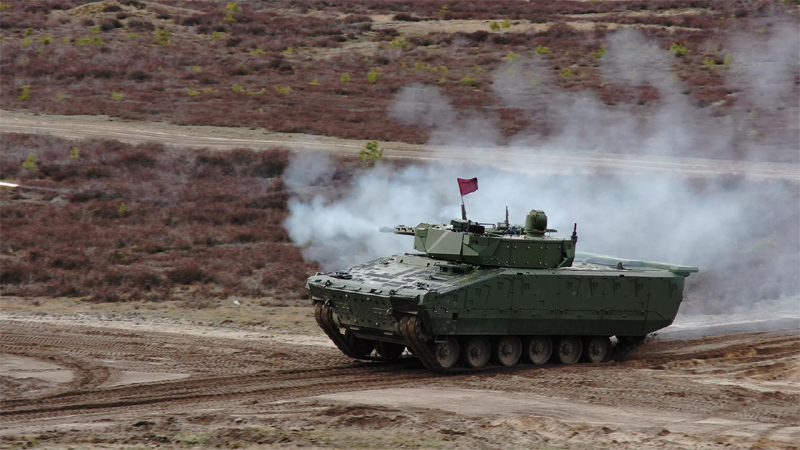
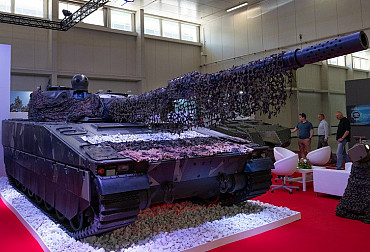
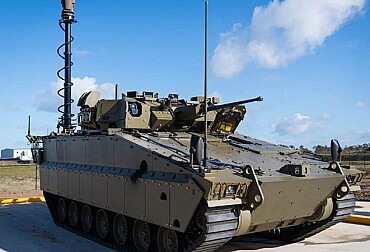
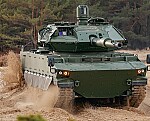
The KF41 Lynx is Rheinmetall’s modular next-generation infantry fighting vehicle, first presented at Eurosatory in 2018 as a larger evolution of the earlier KF31 concept. Built around a common front drive module paired with interchangeable rear mission kits, the design prioritizes flexibility, high protection levels meeting advanced NATO standards against ballistic, mine, and IED threats, and an open digital architecture that supports future upgrades. In the standard IFV configuration the vehicle weighs approximately 44 tonnes, is powered by a Liebherr diesel engine delivering strong power-to-weight performance for a road speed of up to 70 km/h, and carries a crew of three plus up to eight fully equipped infantrymen.
The two-person Lance 2.0 turret typically mounts a 30 mm MK30-2/ABM or 35 mm Wotan autocannon capable of firing both conventional and programmable airburst ammunition, a coaxial 7.62 mm machine gun, and optional Spike LR2 anti-tank missiles in side mission pods. Independent commander and gunner sights, electro-optical sensors, and a modern fire-control system enable precise engagement of targets at ranges out to several kilometres while stationary or on the move, with hunter-killer functionality.
Hungary became the launch customer in 2020 with an order for more than 200 vehicles across multiple variants, including local production at a joint-venture plant in Zalaegerszeg. Further interest has emerged from Italy and Romania, while Rheinmetall has long discussed the possibility of eventual production in Ukraine as part of wider industrial cooperation. For Kyiv the path involved years of discussions, delivery of a single vehicle for testing around late 2024 or early 2025, and the subsequent German-funded batch configured specifically for Ukrainian requirements.
The 21st Brigade has noted the Lynx’s high protection, mobility, spacious compartments, and effective armament as key strengths. Most relevant to the current battlefield is the programmable ammunition, which allows the crew to select the number of rounds and set the precise detonation point – before, at, or beyond the target. As one technician with the call sign Banker explained, against an approaching Shahed-type loitering munition the system locks on and a short burst of five rounds detonates ahead of the target, creating a cloud of fragments that strikes the drone. Crews practiced the same technique against FPV drones during German training, and some reporting indicates the vehicles have already recorded initial successful interceptions of Shahed-type drones in service.
Turning a conventional infantry fighting vehicle into an effective short-range anti-drone asset requires a specific combination of hardware and software rather than simply a large cannon. A stabilized autocannon with sufficient elevation and a useful rate of fire is necessary, as is programmable airburst ammunition – exemplified by Rheinmetall’s AHEAD family or equivalent kinetic-energy time-fuzed rounds – that releases a cloud of tungsten sub-projectiles at a range programmed by a muzzle induction device as the round leaves the barrel. Advanced sensors and fire-control computing must detect, track, and calculate lead for small, relatively slow, or maneuvering aerial targets; dedicated air-threat engagement modes in the software further improve the probability of a first-burst kill.
Crew training on these procedures is essential, and the system must remain usable under electronic-warfare conditions common on the modern battlefield. While such organic capabilities do not replace dedicated short-range air-defense systems such as Rheinmetall’s own Skyranger turret (which can be mounted on Lynx or other platforms), they allow mechanized units to engage low-cost threats with relatively inexpensive kinetic rounds, preserving expensive missiles for higher-value targets and providing distributed protection while maneuvering.
Within Ukrainian service several other Western infantry fighting vehicles already possess or are developing comparable potential. The CV90 family, employed by Ukrainian units including elements linked to the 21st Brigade, includes variants armed with 30 mm, 35 mm, or 40 mm cannons. The 40 mm Bofors-armed CV9040 in particular uses programmable 3P ammunition that creates a fragmentation cloud well suited to drones, while certain 35 mm versions support AHEAD-type rounds; Estonian CV90 crews have demonstrated the concept in exercises by destroying multiple small drones with one or two rounds at ranges up to two kilometres.
American M2 Bradleys, equipped with the 25 mm Bushmaster, have received electronic-warfare jammers and experimental counter-drone remote weapon stations or specialized airburst rounds such as the developmental BADGER munition, although the smaller calibre inherently limits pure kinetic effect against larger loitering munitions compared with 30–40 mm systems. Should German Puma infantry fighting vehicles appear in greater numbers, their MK30-2/ABM cannon is purpose-built for the same class of programmable airburst ammunition.
Across NATO and other Western armies the same pattern is accelerating. Germany’s Puma already fields advanced airburst munitions for multi-role use against ground and aerial targets. CV90 operators continue to enhance counter-unmanned aerial system performance through programmable rounds, sensor upgrades, and active protection systems such as Iron Fist that are being adapted for certain aerial threats. The United States is developing the XM30 successor vehicle around a larger 50 mm cannon with airburst options explicitly considering Group 1–3 drones, while testing autonomous machine-gun stations on existing Bradleys.
Dedicated systems like the Skyranger offer higher specialization and radar-aided engagement, yet organic capabilities integrated into standard infantry fighting vehicles supply mobile, distributed defense that travels with the maneuver force. As inexpensive drones and loitering munitions remain central features of contemporary conflict, platforms such as the Lynx illustrate how modern infantry fighting vehicles must combine traditional infantry-support roles with emerging short-range air-defense functions. Ukraine’s early operational experience with the German vehicles, together with the prospect of further batches and potential local production, offers a practical laboratory for both Ukrainian forces and the wider Western inventory.