
Russia’s Safe Zone Is Gone: Ukraine Strikes Deep in the Caspian Sea
Ukraine’s long-range drone campaign has entered a new and striking phase: the Caspian Sea is no longer beyond reach. In its latest operation, Ukrainian forces targeted a Russian naval vessel in the port of Kaspiisk, Dagestan, underscoring how far Kyiv’s unmanned strike capabilities have evolved and how vulnerable even Russia’s more distant military assets have become.
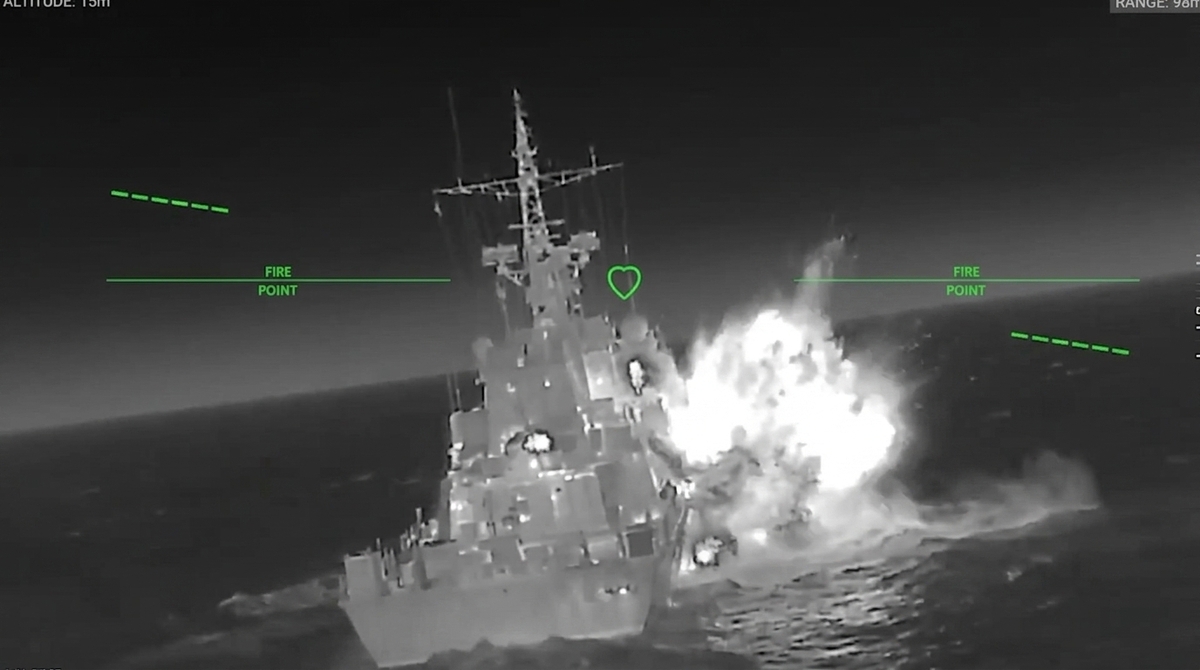
Footage released on May 17 by Ukraine’s Unmanned Systems Forces shows a Fire Point FP-1 attack drone locating and striking a Project 10410 Svetlyak-class patrol boat in the port area. The attack is notable not only because of the target, but because Kaspiisk lies more than 1,500 kilometers from Ukraine’s borders — a distance that would have seemed implausible for a successful Ukrainian drone strike not long ago.
The video suggests this was not a simple hit on a stationary or unprepared vessel. Russian military monitoring communities that reviewed the footage pointed to the area of impact near the stern-mounted AK-630 automatic artillery system. Their analysis indicated the gun may have been fired shortly before the strike, judging by the heat visible around the barrel assembly. If accurate, that would mean the patrol boat was actively trying to defend itself against incoming drones and was still successfully hit. That detail makes the incident more than a symbolic breakthrough. It points to Ukraine’s growing ability to penetrate close-range ship defenses in a contested environment.
The vessel involved belongs to the Svetlyak class, a small but heavily armed patrol boat designed in the Soviet period and introduced into service in the 1990s. Displacing roughly 375 tons, these boats are equipped with a 76 mm automatic cannon, AK-630 close-in weapon systems, and surface-to-air missiles. In the Caspian, they have traditionally been associated with coastal security and patrol duties. But the military significance of the flotilla has increased over time, particularly after Russia used ships in the Caspian to launch Kalibr cruise missiles toward Syria and reportedly integrated the flotilla more broadly into logistics and support activity tied to the war effort.
The strike on the Svetlyak does not stand alone. Ukrainian military reporting from mid-May stated that two Russian military vessels were hit in the port of Kaspiisk. Civilian videos recorded in the area reportedly showed drones flying overhead, explosions, and disorganized Russian air defense fire. Taken together with the official footage released by Ukraine, the incident is supported by a stronger chain of corroboration than is typical for operations in the Caspian, where independent confirmation often arrives slowly or remains incomplete.
Kaspiisk’s location makes the attack especially significant. The city hosts the headquarters of Russia’s Caspian Flotilla and important naval infrastructure on the Caspian coast of Dagestan. Striking targets there demonstrates not just tactical precision, but operational reach on a scale that is reshaping assumptions about Ukraine’s drone warfare. The distance involved suggests improvements in range, endurance, navigation, and mission planning — as well as growing confidence among Ukrainian crews conducting deep-strike operations far from the front.
This latest attack fits into a broader pattern. What once might have been interpreted as an isolated demonstration is now beginning to look like a sustained Ukrainian campaign in the Caspian theater. In November 2024, Ukraine’s Main Intelligence Directorate said it had carried out the first-ever strike on the Caspian Flotilla, damaging the Gepard-class missile ships Tatarstan and Dagestan. Those vessels, both Project 11661 warships, are associated with Kalibr missile capabilities. In December 2025, Ukrainian drones reportedly struck a Project 22460 Okhotnik patrol boat near the Filanovsky oil field platform. The May 2026 operations now appear to mark a third stage in this campaign, with naval targets and offshore energy infrastructure both coming under attack.
That second category of targets may prove even more strategically important. Ukrainian reporting says three Lukoil offshore drilling platforms were also struck: V. Filanovsky, Yuri Korchagin, and Valery Graifer. These are active energy assets in the Russian sector of the Caspian Sea. Ukraine has framed them as infrastructure supporting the logistical and economic needs of Russian occupation forces. If the damage is confirmed, the strikes would signal a major widening of Ukraine’s economic warfare strategy — one that now stretches far beyond refineries and fuel depots in western or central Russia and into offshore energy production in an entirely different maritime theater.
The implications are difficult to ignore. Russia has long operated in the Caspian under the assumption that the region was effectively insulated from external attack. That sense of sanctuary is now being challenged. The repeated appearance of Ukrainian drones over naval and industrial targets in Dagestan suggests that even areas once considered strategically secure may no longer be protected by distance alone.
For Ukraine, the value of these operations extends beyond destruction. They force Russia to disperse defenses, rethink rear-area security, and devote additional resources to places previously seen as safe. For Moscow, the central question is no longer whether Ukraine can reach the Caspian — it clearly can. The question is whether Russian forces can adapt quickly enough to stop the next wave.
If not, the Caspian Sea may become one of the most unexpected pressure points in the wider war: a distant theater transformed by long-range drones into a live battleground.