
Two Billion Euros and Thirty Years Later: Russia’s Nuclear Flagship Rejoins the Fleet
After nearly three decades out of operational service, the nuclear-powered Kirov-class battlecruiser Admiral Nakhimov is completing sea and state trials and is expected to rejoin Russia’s Northern Fleet by late 2026 or early 2027. Laid down as Kalinin and commissioned in 1988, the ship last steamed under her own power in the late 1990s before a refit that began as a repair and became one of the longest and most expensive surface-ship modernizations in modern naval history. At about 252 meters and some 28,000 tonnes full load, she remains the largest non-carrier surface combatant afloat, nuclear-powered, and, on paper, the most heavily armed. Whether that paper strength translates into durable combat power is the question that now matters.
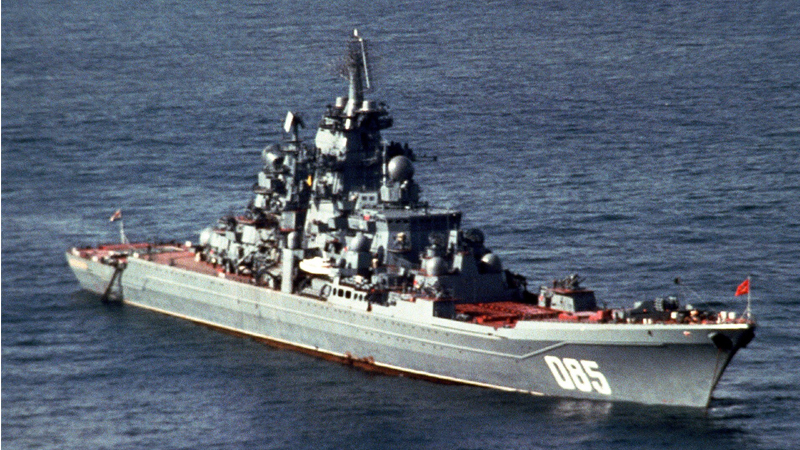
The modernization stripped the old P-700 Granit battery and rebuilt the ship around universal vertical launchers. Open-source assessments converge on roughly eighty UKSK cells for Kalibr land-attack and anti-ship missiles, P-800 Oniks, Otvet anti-submarine weapons, and the 3M22 Zircon hypersonic missile, plus a large area-defense magazine – often estimated near ninety-six cells – drawn from the Fort-M lineage and widely described as a naval S-400-class capability, layered with Pantsir-M close-in systems, a dual-purpose 130-millimeter gun, torpedoes, anti-submarine rockets, and up to three Ka-27 helicopters. Combined figures of around 176 major missile cells are commonly cited.
Two refurbished KN-3 reactors and backup boilers still drive the ship toward 32 knots with theoretically unlimited nuclear endurance. Sensors, combat management, electronic warfare, and damage-control systems were also replaced, so the hull that returns is closer to a new warship than a restored relic. That does not make the hull new. It is a 1980s design optimized for a different era of naval warfare.
Inside the Russian navy the ship’s role is narrower and more coherent than the “world’s most powerful cruiser” slogan suggests. She is slated as flagship of the Northern Fleet at Severomorsk, with a primary mission of helping defend the Arctic bastion in which Russia’s ballistic-missile submarines operate. Nuclear range, a deep surface-to-air magazine, and long-range strike weapons suit a ship that is meant to sit under land-based air cover, screen approaches to the Barents and Kara Seas, complicate NATO operations in the Norwegian Sea and GIUK gap, and serve as a command node for surface groups.
She also replaces rather than reinforces her sister Pyotr Velikiy, which is widely expected to retire without a comparable overhaul. The class that once numbered four operational hulls will, in practice, shrink to one modernized ship. Prestige and nuclear-deterrent protection therefore sit together: Admiral Nakhimov is both a political symbol and a specialized Arctic asset, not a freely roaming blue-water hunter of carrier groups.
The cost of that specialization is severe. Serious modernization work began around 2013–2014 on a contract originally reported near 50 billion rubles and an expected return around 2018. Deadlines slipped repeatedly. Unofficial Russian figures now cluster around 200 billion rubles – about two billion euros or 2.3 to 2.7 billion dollars – while some Western assessments of the full multi-decade bill run as high as five billion dollars.
Operating costs will remain high: a crew of roughly seven hundred, nuclear propulsion and safety regimes, specialized yard support, and a maintenance burden that already consumed three sister ships. Opportunity cost is the sharper critique. The same money could have bought several modern frigates or corvettes carrying the same Kalibr and Zircon missiles across multiple hulls. Russia chose concentration. It now owns one irreplaceable magazine rather than a distributed force.
For NATO navies the threat is real but bounded. Zircon, if its claimed Mach 8–9 performance and maneuvering hold in combat conditions, compresses reaction time for shipboard air defenses and can hold surface groups at risk from the Barents into the Norwegian Sea. Oniks and Kalibr add volume and land-attack reach. The air-defense loadout can protect nearby Russian units and force alliance planners to commit extra surveillance, tankers, interceptors, and magazine depth to the High North.
A fast nuclear flagship that can surge toward the GIUK gap is not something commanders can ignore. It does not, however, change the overall correlation of forces. One ship cannot saturate multiple carrier strike groups, cannot replace Russia’s depleted large-surface force, and cannot operate far from friendly air cover without becoming the highest-value target on the map. The operational problem for NATO is allocation: how many scarce assets must be tied down to watch one hull. The operational problem for Russia is that those same assets exist to kill that hull.
In a hot conflict the battlecruiser’s greatest dangers are the same features that make her impressive: size, uniqueness, and concentration of value. NATO attack submarines remain the classic killer of large surface ships in northern waters; even upgraded Paket-NK, Otvet, and helicopters do not erase that threat in the Barents, a crowded and well-practiced allied hunting ground. Long-range anti-ship missiles, stealth aircraft, and stand-off weapons launched from well beyond the ship’s own horizon would exploit the limits of any single-ship radar picture. Ukraine’s war has already shown that cheap maritime drones and coastal missiles can drive expensive Russian ships into port or sink them; Arctic distances and weather reduce that particular threat but do not abolish unmanned systems, loitering munitions, or satellite-cued strikes.
Space-based ISR, undersea sensors, and allied targeting networks would make a 252-meter nuclear cruiser one of the easiest large objects to find and keep found. Damage to reactors or magazines would be politically as well as militarily catastrophic. Maintenance downtime, crew quality after years of industrial delay, and the absence of a matching escort fleet further shrink the window in which she can fight as designed. The ship that returns to service is therefore both a serious Arctic combatant and a monument to a navy that can still restore a Cold War giant, but can no longer afford a class of them – and may not be able to keep this one at sea if a war forces it out from under the umbrella of the Kola Peninsula.