
Ukraine Hits Russian Electronics Plant and Oil Refinery in Overnight Missile and Drone Strikes
Ukraine has carried out another long-range strike campaign against targets inside Russia, hitting two facilities tied to Moscow’s war effort: the Proton plant in Oryol and the Saratov Oil Refinery.
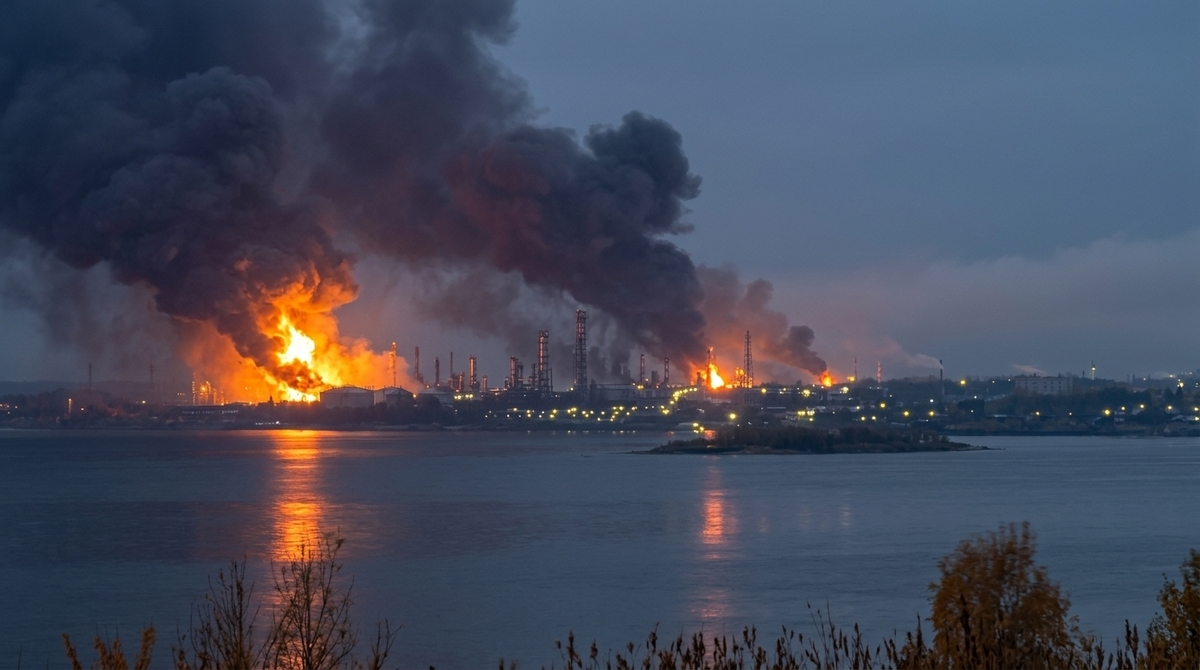
The attacks took place overnight on November 7 and underline a familiar pattern in Ukraine’s strategy: rather than focusing only on front-line positions, Kyiv is increasingly targeting the industrial and logistical systems that help sustain Russia’s military machine.
According to the monitoring resource Exilenova+, Ukraine’s Defense Forces launched a missile strike against the Proton plant in the city of Oryol. A fire was reported near Building No. 48 of the facility, with the impact area geolocated at coordinates 52.984779, 36.056301.
The type of missile used has not been officially confirmed, but Militarnyi reported that Flamingo cruise missiles were likely involved. Russian sources had earlier claimed launches of such missiles had been detected.
The choice of target is significant. The Proton plant is not an ordinary industrial site. It specializes in optoelectronics, semiconductor devices, and electronic components — precisely the kind of technology modern weapons depend on. According to the report, its products are used in Russian military systems, including Iskander-M ballistic missiles and Pantsir-S1 air defense systems.
That makes the plant a valuable target. Damaging such a facility does not just destroy buildings or equipment; it can disrupt supply chains for weapons that Russia uses both on the battlefield and against Ukrainian cities.
The strike on Oryol was not the only attack that night. Ukrainian drones also hit the Saratov Oil Refinery, where several separate fires were observed across the site.
The refinery belongs to Rosneft and has a design capacity of around 7 million metric tons of oil per year. It produces gasoline, diesel, marine fuel, bitumen, and other petroleum products. Militarnyi also notes that the facility is involved in supplying the Russian army with fuel and lubricants.
For Ukraine, refineries are a logical target. Russia’s war depends heavily on fuel — for tanks, trucks, aircraft, generators, logistics convoys, and rear-area infrastructure. Every successful strike on refining capacity or fuel distribution adds pressure to a system that must already support a massive war across a long front.
The Saratov facility has been attacked before. Militarnyi reported that it was last struck on September 11. The Proton plant has also been targeted previously; on October 23, Storm Shadow cruise missiles hit the same facility.
That repeat targeting suggests Ukraine is not conducting isolated symbolic strikes. Instead, it appears to be returning to selected industrial nodes whose destruction or repeated disruption could have cumulative military effects.
The broader message is clear: distance is no longer a guarantee of safety for Russia’s defense industry. Oryol and Saratov are far from the immediate front line, yet both remain within reach of Ukrainian long-range strike systems.
This creates a strategic problem for Moscow. Russia must defend not only its troops in occupied Ukrainian territory, but also refineries, arms plants, airfields, depots, rail hubs, and command infrastructure across a vast territory. Each new Ukrainian strike forces Russia to stretch air defenses, repair damaged sites, and reassess which facilities are most vulnerable.
The attack on the Proton plant is especially important because of its connection to advanced weapons. Optoelectronics and semiconductor components are essential for guidance, targeting, detection, and control systems. Even partial disruption at such a facility can complicate production schedules or force Russia to rely on alternative suppliers and stockpiles.
The Saratov refinery, meanwhile, belongs to a different but equally important category: energy infrastructure that feeds the war economy. Ukraine has repeatedly used drones to hit Russian fuel and oil facilities, seeking to weaken the flow of refined products into military and industrial use.
Neither strike is likely to change the war by itself. But together, they reflect a long-term campaign aimed at making Russia’s war effort more expensive, less predictable, and harder to sustain.
For Ukraine, long-range strikes serve several purposes at once. They damage military-related infrastructure, force Russia to spend more resources on homeland defense, and demonstrate that critical targets deep inside Russian territory can be reached. They also impose psychological pressure by bringing the consequences of the war closer to Russian industrial centers.
The November 7 attacks also show how Ukraine is combining different strike tools. Missiles appear to have been used against the Proton plant, while drones targeted the Saratov refinery. This mix complicates Russian air defense planning, as cruise missiles and UAVs present different detection, interception, and response challenges.
Russia has invested heavily in air defense, but protecting every valuable facility across such a large country is extremely difficult. Ukraine appears to be exploiting that problem by selecting targets whose damage can have military, logistical, or economic consequences.
The fires in Oryol and Saratov may eventually be extinguished, and Russia may repair the physical damage. But the larger issue remains: Ukraine has shown again that it can reach into Russia’s rear and strike assets linked to weapons production and military supply.
That is why these attacks matter beyond the immediate flames. They are part of a wider contest over endurance. Russia is trying to outlast Ukraine through mass, industry, and attrition. Ukraine is trying to offset Russia’s size by striking the systems that feed its war machine.
The overnight strikes on the Proton plant and Saratov Oil Refinery fit directly into that approach. They were not random attacks on Russian territory. They targeted electronics and fuel — two things without which modern armies cannot fight effectively for long.
And as Ukraine continues to expand its long-range strike capabilities, Russia’s rear areas may become less of a sanctuary and more of an extension of the battlefield.