
Ukraine Strikes Russia’s Rare 5,000-Km Electronic Warfare Giant in Crimea. Why the Murmansk-BN Matters
A Ukrainian drone has struck one of Russia’s rarest long-range electronic warfare systems in occupied Crimea. The target was the Murmansk-BN, a massive complex designed to intercept and jam communications over extraordinary distances. The strike may have destroyed more than just a set of antennas—it could also open a new window for Ukraine’s future deep strikes.
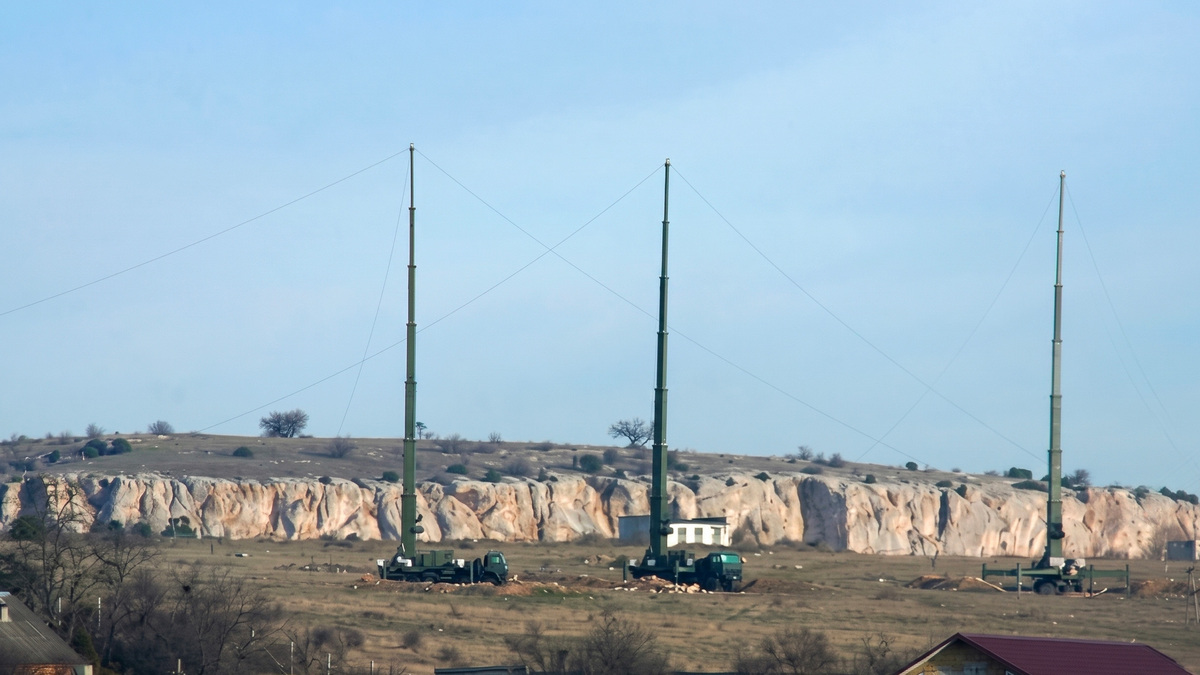
Something unusual happened near Cape Fiolent in occupied Crimea on the night of July 27.

Ukrainian military intelligence targeted a Russian Murmansk-BN electronic warfare system, according to Ukraine’s Defence Intelligence Directorate. The strike is believed to be the first known Ukrainian attack on this particular system since Russia launched its full-scale invasion.
And the target was far from ordinary.
The Murmansk-BN is one of Russia’s most powerful long-range electronic warfare platforms, designed to detect and disrupt shortwave communications across enormous distances. Russia claims it can operate at ranges of up to 5,000 kilometers, although that maximum figure remains unverified.
A giant designed to reach far beyond the battlefield
Electronic warfare rarely produces the spectacular images associated with missiles or fighter jets.

There may be no explosion at the target being attacked.
Instead, the battlefield can simply go silent.
Signals disappear. Communications become unreliable. Navigation systems can become confused. Electronic links between military systems can be disrupted.
That is precisely the kind of warfare the Murmansk-BN was designed for.
The system is intended to conduct reconnaissance and jamming of shortwave communications, while also being capable of interfering with satellite navigation. Its claimed range of up to 5,000 kilometers would theoretically allow it to affect communications far beyond the immediate combat zone.
That makes the system strategically important—not because it destroys targets itself, but because it can potentially make it harder for other weapons and forces to operate effectively.
The Crimean system was not small—or easy to move
The Murmansk-BN is a striking piece of military hardware.
It is not a single vehicle that can simply drive into position, switch on and disappear again.
The system consists of multiple components, including four antenna masts roughly 32 meters tall. Two are mounted on KamAZ trucks while two others are carried on trailers. The complex also includes a jamming vehicle, a presumed generator vehicle and a command post.
Once deployed, cables are stretched between the masts to create the antenna array.
Setting the entire system up is reportedly expected to take around 72 hours.
That creates a serious vulnerability.
A system capable of reaching thousands of kilometers may be enormously powerful—but it is also difficult to conceal and difficult to relocate quickly once deployment begins.
And that appears to have mattered in Crimea.
The drone struck at an unusual moment
Footage released after the attack appears to show a Ukrainian drone hitting a trailer-mounted antenna mast.
There is an important detail, however.
According to Defense Express, the mast appears to have been positioned separately from the rest of the complex. This could indicate that the Murmansk-BN was not fully assembled or operational when the attack occurred.
In other words, Ukraine may have struck the system while it was particularly vulnerable.
That distinction matters.
Destroying one antenna mast is not necessarily the same thing as destroying an entire Murmansk-BN complex.
But even damaging a critical component can force Russia to repair, replace or redeploy expensive equipment—and potentially reduce the system's ability to interfere with Ukrainian operations.
Why Ukraine cares about electronic warfare
The importance of the strike becomes clearer when looking beyond the antenna itself.
Ukraine increasingly relies on drones and other long-range weapons to attack Russian targets deep behind the front.
Those weapons depend on navigation, communications and increasingly sophisticated electronic systems.
Russia, meanwhile, has invested heavily in electronic warfare designed to interfere with exactly those capabilities.
A powerful long-range EW system operating from Crimea could therefore create problems for Ukrainian systems operating across a large area.
Removing it could have the opposite effect.
Defense Express assessed that the strike could improve satellite navigation for Ukrainian drones in the area and reduce interference with shortwave communications.
That could become particularly significant as Ukraine continues expanding its long-range strike campaign.
The Baltic connection makes the system even more interesting
The Murmansk-BN's importance is not limited to Ukraine.
A similar system deployed in Russia's Kaliningrad region has been associated with satellite-navigation disruptions affecting the Baltic region. Reports have linked such interference to problems experienced by aircraft and ships, including flight diversions and disruptions at airports.
This illustrates why Russia's long-range EW systems are watched so closely.
Their purpose is not simply to defend the vehicle carrying them.
They are designed to influence the electromagnetic environment over a huge area.
That makes them a kind of invisible battlefield infrastructure.
A rare target—and potentially a warning
The Murmansk-BN has reportedly been present near Cape Fiolent since Russia occupied Crimea in 2014, and the systems were again observed there after the full-scale invasion began.
Defense Express notes that the Ukrainian strike represents the first known attack on a Murmansk-BN during the full-scale war.
That fact alone makes the operation noteworthy.
But its significance could extend further.
Ukraine has spent much of the war hunting Russian radars, air-defense systems and electronic warfare assets. These systems are increasingly becoming high-value targets because they form the protective and enabling infrastructure around Russia's military operations.
The message is straightforward:
If a Russian system can interfere with Ukrainian weapons, Ukraine will try to find it—and eventually reach it.
The 5,000-kilometer figure hides an important caveat
The number sounds extraordinary.
Five thousand kilometers would put the claimed maximum range of the Murmansk-BN on a completely different scale from many battlefield electronic warfare systems.
But it is important not to mistake the advertised figure for a proven combat capability.
The 5,000-kilometer range is a Russian claim and has not been independently verified, according to Defense Express.
Real-world effectiveness depends on numerous factors, including the frequency being targeted, atmospheric conditions, antenna configuration, power, terrain and the characteristics of the opposing communication system.
The Murmansk-BN should therefore not be viewed as a magical electronic shield capable of automatically jamming everything within a 5,000-kilometer circle.
Its real importance lies in the strategic role it was built to perform.
The bigger battle is becoming invisible
The destruction of a Murmansk-BN antenna may not look as dramatic as the destruction of a tank column or missile launcher.
But modern warfare increasingly depends on something that cannot be seen in photographs: the electromagnetic spectrum.
Drones need navigation and communications.
Commanders need secure links.
Sensors need to transmit data.
Weapons need guidance.
And armies need to know where their forces—and their targets—are.
Electronic warfare attacks that invisible infrastructure.
That is why the Ukrainian strike near Cape Fiolent could prove more important than the flames visible in the footage suggest.
The Murmansk-BN was designed to make Ukraine's electronic battlefield more difficult.
Now Ukraine has demonstrated that even a system advertised as capable of reaching thousands of kilometers is itself vulnerable.
And if Ukrainian forces can systematically remove Russia's long-range electronic warfare assets, the next wave of deep strikes could face fewer obstacles than the Kremlin would like.