
Ukraine’s Special Operations Forces Take Aim at Russia’s Fuel Chain in Crimea
Ukraine has intensified its campaign against Russian military logistics in occupied Crimea, launching a nighttime drone operation that targeted two key fuel infrastructure sites used to support Moscow’s forces on the peninsula and beyond.
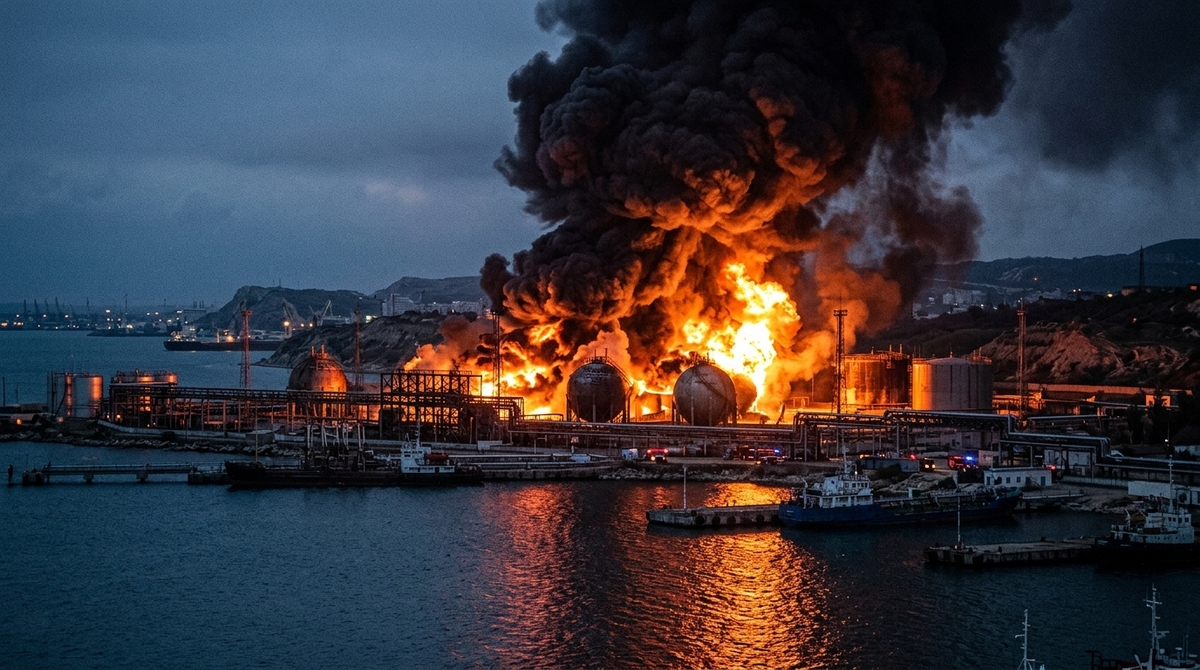
On the night of June 7, Ukrainian Special Operations Forces carried out strikes on the Semikolodezyanska oil depot in the village of Yedi-Kuyu and on a separate oil terminal in Feodosia. The operations were later confirmed by the Special Operations Forces command, which framed the attacks as part of a broader effort to weaken Russia’s ability to sustain military operations through long-range, asymmetric pressure.
The first target, the Semikolodezyanska oil depot, lies roughly 200 kilometers from the line of contact. Despite its distance from active frontline combat, the site plays a practical role in the Russian military fuel chain. It functions as a transshipment hub where fuel oil, diesel, bitumen, and other petroleum products are stored and redistributed. The facility includes nine storage tanks with capacities ranging from 700 to 3,000 cubic meters. From there, fuel is loaded onto tanker trucks and moved across occupied Crimea and other Russian-held territories for military use.
The second strike hit an oil terminal in Feodosia, about 250 kilometers from the front. This site appears even more significant in terms of scale and logistics. The terminal includes seven fuel tanks with capacities of 10,000 and 20,000 cubic meters and serves as a transshipment point for both rail and maritime fuel deliveries. It is used to support fuel supplies across occupied Crimea, including emergency delivery needs on the peninsula.
By striking both facilities in a single operation, Ukraine appears to have targeted not just fuel storage, but the wider system that allows Russian forces to receive, move, and sustain petroleum supplies across occupied territory. Attacks like these are designed to create ripple effects far beyond the immediate damage, potentially disrupting transport routes, increasing delivery delays, and forcing Russia to divert resources into protection and repair.
The Special Operations Forces made that strategic purpose clear in their statement, saying that the destruction of enemy oil infrastructure reduces Russia’s economic and logistical capabilities. The command added that Ukrainian forces are continuing asymmetric actions aimed at strategically weakening the enemy’s capacity to wage war.

The operation fits into a larger pattern of Ukrainian strikes on military and dual-use infrastructure located deep behind Russian lines. Rather than focusing only on direct battlefield attrition, Kyiv has increasingly used drones to hit depots, terminals, airfields, naval facilities, and industrial assets that underpin Russian combat power. The approach is meant to stretch Russian defenses, raise the cost of occupation, and chip away at the support systems that keep troops and equipment operational.
It also follows an earlier operation in which Ukrainian Special Operations Forces, together with the Security Service of Ukraine, used drones to strike the Kronstadt naval base of Russia’s Baltic Fleet. Taken together, these operations suggest a continued emphasis on long-range precision strikes against high-value logistical and military infrastructure.
For Ukraine, the logic is straightforward: every damaged fuel depot, disrupted terminal, or threatened supply hub adds friction to Russia’s war machine. And in a conflict where logistics often matter as much as firepower, that friction can have outsized consequences.