
Ukraine’s Low-Cost Drone Kill Strategy Could Redefine Modern War
The challenge is no longer just about stopping a handful of incoming missiles. It is about surviving relentless, layered attacks designed to exhaust expensive defenses and force defenders into losing economic trades. Russian strike packages now often begin with huge waves of one-way attack drones, including jet-powered Shahed variants and decoys, sent in first to overwhelm detection systems and saturate air defenses. Those swarms are then followed by cruise missiles, while ballistic missile launches continue to add pressure at a historic pace.
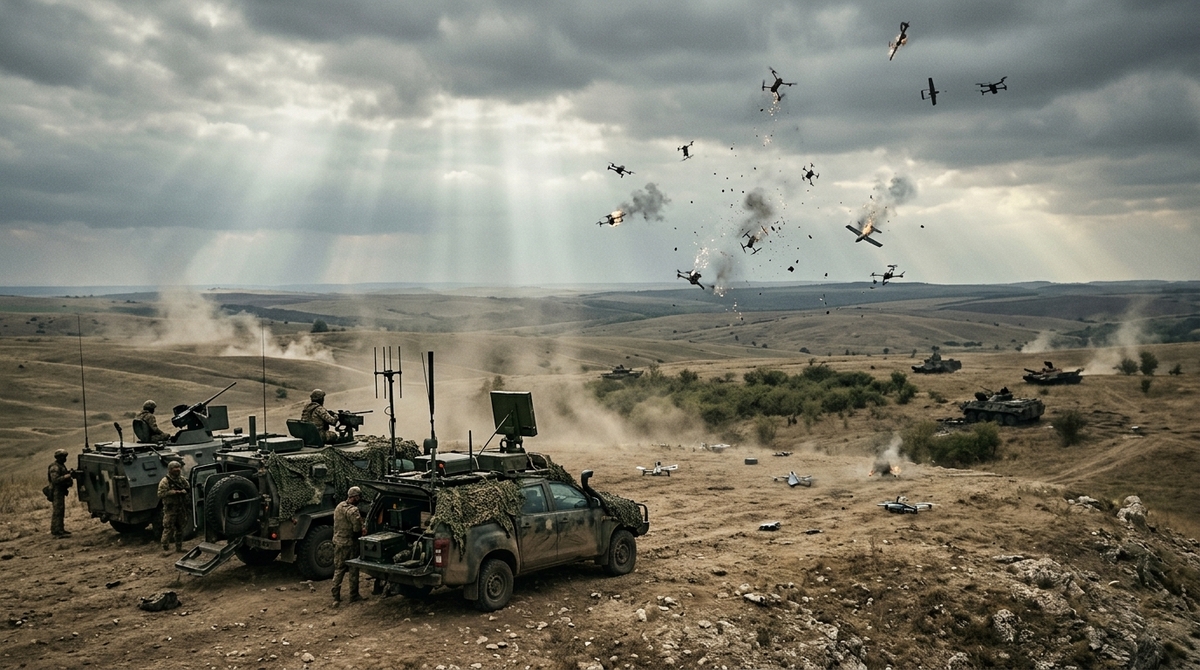
In that environment, Ukraine has been forced to answer a brutal question: how do you destroy cheap incoming threats without burning through your most valuable weapons, aircraft, and flight hours?
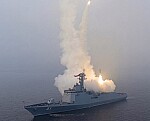
Its response has been practical rather than glamorous. Instead of leaning only on high-end systems such as Patriot batteries, Ukraine has built a denser and more distributed shield made up of layered short-range air defense systems and mobile teams spread across depth. These dispersed units have become the first line of defense against many incoming drones, especially the Geran class, and they reflect a wider shift in how the country now fights.
One of Ukraine’s most important wartime adaptations is organizational, not just technological. Responsibility for air defense is no longer treated as something reserved only for higher headquarters. Lower-level units have increasingly absorbed local air defense, fires, and battlefield response functions for themselves. That matters because Ukraine cannot count on uncontested skies or predictable operational conditions. It has had to create a system that reacts faster, closer to the threat, and with more freedom at the tactical edge.
This decentralization is paying off because the threat itself has changed. Russian attacks are no longer simply about precision strikes by a limited number of missiles. They are increasingly designed as layered saturation campaigns. If the goal is to flood the airspace with enough drones and decoys to force expensive intercepts, then the defender needs affordable tools that can be fielded in volume. Ukraine’s answer has been to combine mobile ground-based teams with a wider range of intercept methods, including some that would have seemed unconventional before the war.
Among the most striking of these adaptations is the use of helicopters and modified fixed-wing propeller or turboprop aircraft armed to engage drones. These platforms offer a more sustainable and lower-cost way to hunt one-way attack drones than relying exclusively on fighter jets or premium missile interceptors. The logic is simple: when the enemy can produce thousands of drones every month, the defender cannot afford to meet every target with the most expensive tool in the arsenal.
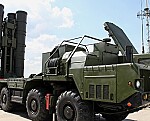
That does not mean fighter aircraft have disappeared from the fight. Far from it. Since last year, Ukraine has used Western jets including the F-16 and Mirage 2000-5 to shoot down aerial threats, with notable success against Geran and Gerbera drones. Ukrainian pilots have also adapted their tactics to reduce cost and improve survivability. Rather than waste scarce missiles on every interception, they have increasingly turned to 20 mm cannon fire and AGR-20 rockets.
Even so, using fast jets against relatively slow, small drones creates its own dangers. Pilots must deal with high closure speeds, short visual engagement windows, and the very real risk of being hit by fragments from exploding targets. Safer and more effective intercept tactics have therefore become just as important as the weapons themselves. Ukraine is not only improvising; it is refining those improvisations under combat conditions.
Another major shift has taken place in command authority. Ukrainian Air Force pilots now have greater freedom to divert from preplanned missions if they identify a high-value opportunity, such as a radar or missile launcher. That kind of flexibility may sound procedural, but in war it can be decisive. It shortens the time between detection and action, and it gives experienced crews more room to exploit fleeting openings instead of waiting for centralized approval.
Still, the use of F-16s at scale against drone waves comes with a serious cost. Flying hours add up quickly. Airframes wear down. Maintenance demands grow. What looks tactically effective in the moment can become strategically unsustainable if it consumes aircraft life on targets that cheaper systems might handle. That is why Ukraine’s evolving approach is increasingly about reserving its fighters for missions where they matter most: strike operations, high-priority intercepts, and threats such as cruise missiles that are harder for lower-cost systems to defeat reliably.
The urgency of that shift is growing because Russia is not standing still. Faster jet-powered Shahed variants are creating a new problem for Ukrainian defenders. These drones move too quickly for some of the cheaper countermeasures that worked against earlier models, including certain interceptor drones and first-person-view systems. In other words, the cost battle is escalating again. Every time Ukraine finds a more affordable answer, the threat evolves.
What makes Ukraine’s air defense effort so significant is not that it has found a perfect system. It has not. The deeper lesson is that modern air defense is becoming a contest of adaptation, economics, and endurance as much as one of firepower. Ukraine is building a model shaped by necessity: distribute responsibility, preserve expensive assets, use layered defenses, and match the interceptor to the target whenever possible.
That model may prove relevant far beyond this war. In an age of mass-produced drones and saturation attacks, the side that survives may not be the one with the most advanced weapons, but the one that learns fastest how to use the right weapon at the right cost.